














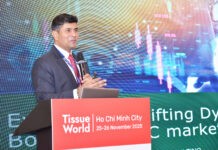


First comprehensive study reveals gap between marketing promises on sustainability and the measurable environmental impact. Report for TWM by North Carolina State University’s Naycari Forfora (pictured), Isabel Enriquez, Hasan Jameel, Richard Venditti, Luana Desbessel, Qingshi Tu, Erlantz Lizundia, Ronalds Gonzalez (pictured).
Once a niche product, bamboo tissue paper now sits at the centre of the sustainability conversation in the $50bn US hygiene market. Its packaging purports a compelling story – “tree-saving,” “eco-friendly,” “carbon-neutral.” The message is clear: bamboo grows fast, so it must be better for the planet, with claims of three-to-seven-year maturity cycles compared to 65 years for northern softwoods. For many consumers – especially younger generations – those promises are enough to justify paying more for what appears to be the greener choice (Vivas et al., 2024).
However, new research from North Carolina State University (NCSU) reveals a disparity between claims for sustainability and the reality of impact on the environment.
In a comprehensive life cycle assessment (LCA) study, NCSU researchers evaluated the full cradle-to-grave carbon footprint of Chinese bamboo-based consumer bath tissue (CBT) and compared it with US-manufactured tissue made from Brazilian bleached eucalyptus kraft and Canadian northern bleached softwood kraft (Ortega et al., 2024). The results challenge long-standing assumptions about bamboo’s environmental superiority.
The scientific article reveals a clear deviation from prevailing assumptions: Chinese bamboo-based tissue exhibits a cradle-to-grave carbon footprint up to 32% higher than that of US wood-based tissue products manufactured with eucalyptus fibre from Brazil and softwood fibres from Canada. Importantly, the study highlights that technological efficiency and energy infrastructure exert a far greater influence on overall environmental performance than raw fibre type – a nuance frequently missing from industry sustainability claims.
Why bamboo’s environmental promise falls short
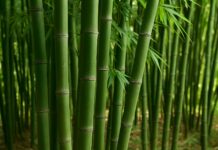
Bamboo’s appeal as a fibre source is understandable. This fast-growing grass matures in three to seven years compared to eucalyptus at seven years and managed northern softwoods at 65 years (working forests). Its rapid growth rates require less land than softwood forests. These characteristics have fuelled narratives that emphasise bamboo’s environmental superiority.
China dominates global bamboo pulp production, with substantial capacity that primarily produces kraft bleached bamboo pulp. Initially, bamboo-based tissue paper entered the US market as finished products imported from China. However, market expansion has made importing bamboo tissue jumbo rolls for tissue manufacturing or market pulp for US domestic processing increasingly feasible for integrated mills with converting facilities.
Despite bamboo’s growing market presence, quantitative environmental comparisons had remained absent until now. Marketing claims relied on generalised assumptions about rapid growth and low input requirements without a comprehensive LCA to support them. This data gap left procurement managers, sustainability officers, and consumers making decisions based on incomplete information.
Methodology: establishing clear comparisons
The NCSU research team conducted a cradle-to-grave carbon footprint analysis encompassing market pulp production (performed following detailed engineering principles of mass and energy balances and process simulation), tissue manufacturing, transportation, and end-of-life disposal. The study compared five scenarios across different furnish compositions and production technologies:
- US Production (Non-integrated mills):
- Traditional furnish: 70% Bleached Eucalyptus Kraft (BEK) and 30% Northern Bleached Softwood Kraft (NBSK)
- Bamboo-containing furnish: 70% Bamboo Bleached Kraft (BBK) and 30% BEK
- Both furnishes were evaluated using Light Dry Creped (LDC) and Creped Through Air Drying (CTAD) tissue manufacturing technologies
- Chinese Production (Virgin-integrated mills):
- 70% BBK / 30% BEK using LDC technology, transported to the US
The analysis used process simulation for kraft pulping, industry databases for operational conditions, and comprehensive LCA software. Multiple mills across Canada, China, and Brazil were analysed to represent regional production conditions through productivity-weighted averages.
The data speaks: why technology outshines fibre type:
Market pulp: where geography beats fibre selection
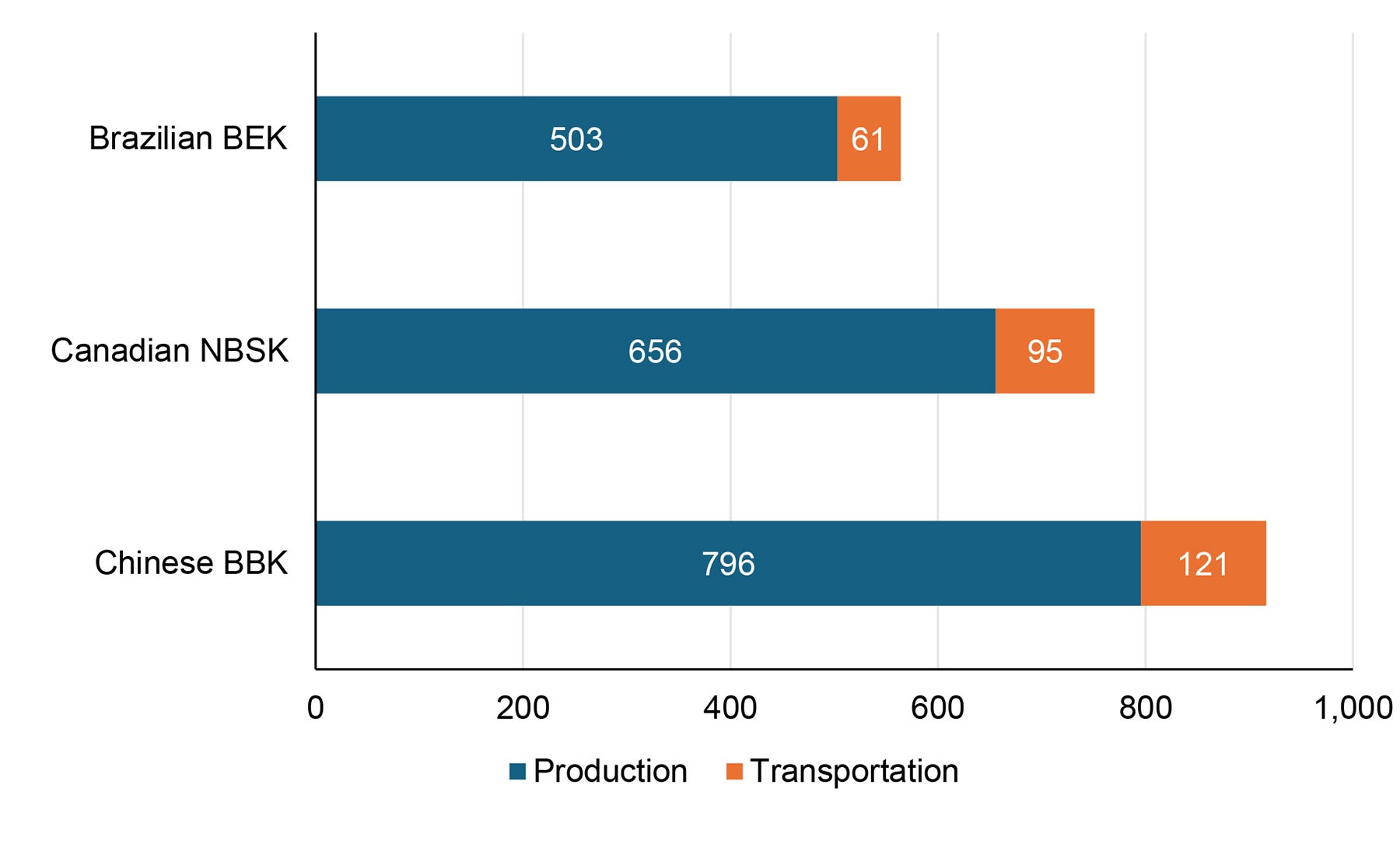
The carbon footprint analysis of market pulps revealed critical insights about production efficiency and energy sources. Canadian NBSK production registers a GWP (global warming potential) of 656 kg CO2eq per air-dry ton (ADt) at the mill gate, whereas Chinese BBK shows 796 kg CO2eq/ADt—23% higher than NBSK. Brazilian BEK demonstrates the lowest footprint at 503 kg CO2eq/ADt. Fig. 1 presents the carbon footprint of pulps delivered to the Southeast US.
The primary driver behind BBK’s higher impact is China’s energy infrastructure. BBK mills show lower power self-sufficiency and rely heavily on coal-dominated electricity grids. Fossil fuel combustion at pulp mills – particularly coal use – accounts for a substantial portion of total emissions across all market pulps.
Regional grid composition dramatically affects outcomes. If Chinese BBK mills operated in provinces with cleaner electricity grids, their carbon footprint could decrease by approximately 22%. This finding underscores that geography and infrastructure – not inherent fibre properties – drive environmental performance.
Canadian NBSK mills achieve higher power self-sufficiency, with renewable capacity playing a significant role in electricity supply. This advantage, combined with the use of natural gas rather than coal, significantly reduces their carbon footprint, despite softwood’s longer bleaching sequences and higher chemical requirements due to its higher lignin content.
Finished Products: The 39% Technology Gap
When market pulps are converted to finished tissue paper rolls, the technology choice emerges as the dominant factor in environmental impact:
- GWP of LDC Products (Medium Quality):
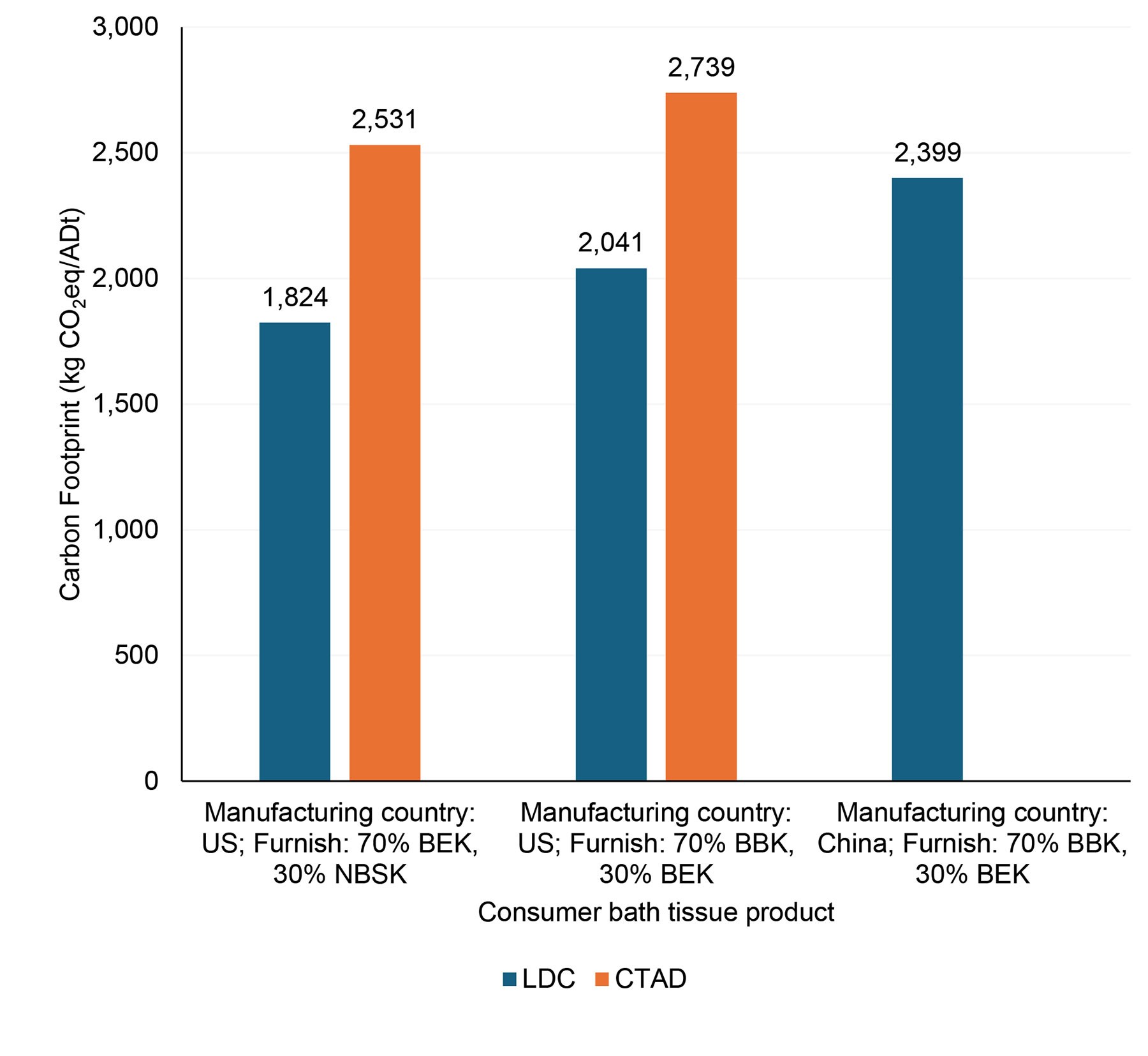
- US traditional (70% BEK/30% NBSK): 1,824 kg CO2eq/ADt
- US bamboo-containing (70% BBK/30% BEK): 2,041 kg CO2eq/ADt (+12%)
- Chinese bamboo-based (70% BBK/30% BEK): 2,400 kg CO2eq/ADt (+32% vs US traditional)
- GWP of CTAD Products (Premium Quality):
- US traditional (70% BEK/30% NBSK): 2,531 kg CO2eq/ADt
- US bamboo-containing (70% BBK/30% BEK): 2,739 kg CO2eq/ADt (+8%)
The results demonstrate that CTAD technology increases carbon footprint by 39% compared to LDC for comparable furnish compositions. This substantial increase is attributed to CTAD’s significantly higher energy consumption, which is a result of the superior drying requirements that enhance softness and absorbency for premium products.
Tissue machine technology’s overwhelming influence means that selecting LDC over CTAD reduces carbon footprint more than switching from bamboo to wood fibres. Chinese bamboo-based CBT produced with LDC technology exhibits lower emissions (2,400 kg CO2eq/ADt) compared to US wood-based CTAD products (2,531 kg CO2eq/ADt), although this comparison involves different quality tiers (Fig. 2).
Products performance
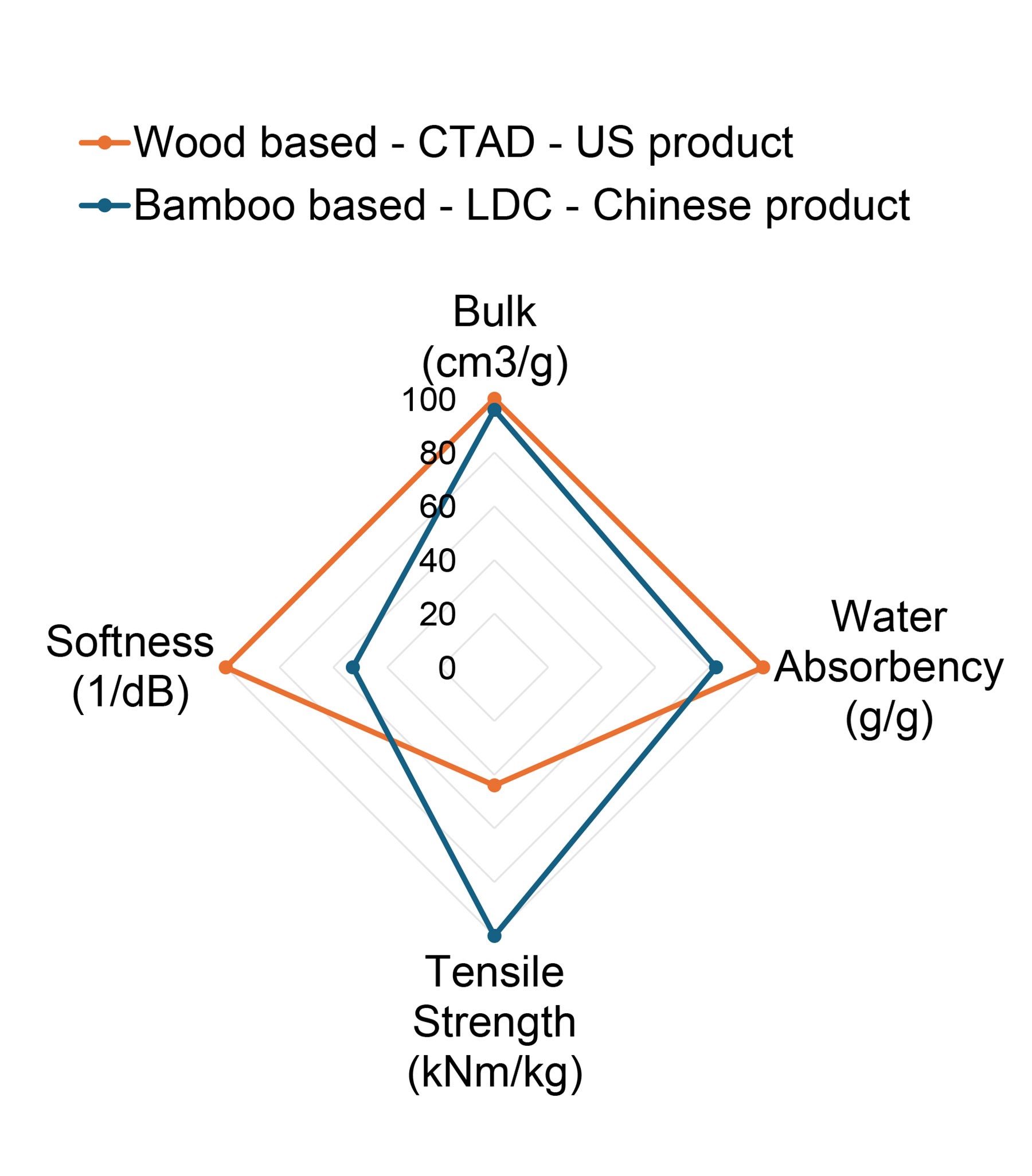
Besides, the mechanical properties of selected commercial wood and bamboo tissue products differ considerably (Fig. 3). US products, characterised by wood furnish and CTAD technology, exhibit higher bulk and water absorbency. Moreover, softness is the property with the greatest difference, with LDC products roughly half as soft as CTAD products. Therefore, increases in product quality led to a higher carbon footprint.
Beyond carbon: eight environmental categories where bamboo underperforms
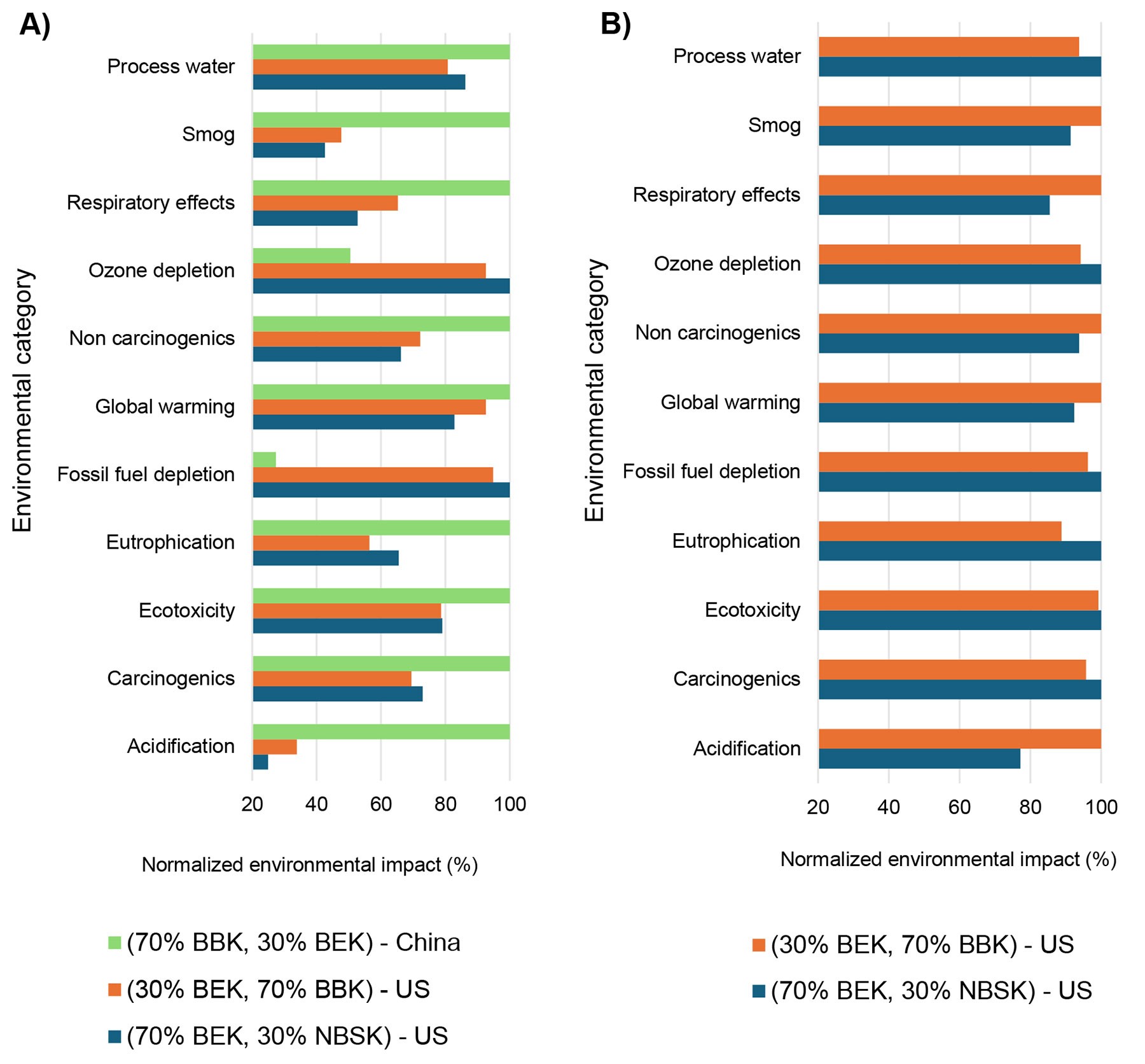
Beyond carbon footprint, the comprehensive assessment across ten impact categories revealed that Chinese bamboo-based production shows higher impacts in eight categories (Fig. 4), including:
- Smog formation
- Respiratory effects
- Acidification
- Non-carcinogenic effects
- Ecotoxicity
These impacts are directly attributed to China’s dependence on coal in its electricity grids and on-site fuel choices. Traditional US furnish (70% BEK/30% NBSK) exhibits higher ozone depletion and fossil fuel depletion, primarily due to upstream sawmill processing of softwood chips.
Water consumption also favours wood-based production. Chinese BBK products consume 45.7 m³ per ADt—24% higher than comparable US bamboo-containing products and 16% higher than traditional US products.
Soil carbon and biogenic considerations
The research team conducted supplementary analyses on soil organic carbon (SOC) sequestration potential and GWPbio (biogenic global warming potential) factors to address the purported advantages of bamboo, specifically its shorter rotation periods.
SOC Sequestration
Including SOC sequestration reduced carbon footprints by 2.6-18.2% for BEK/NBSK products and 4.4-21.8% for bamboo-containing products. Bamboo’s higher root biomass provides some relative benefit. However, even accounting for SOC, the ranking remained unchanged: US-manufactured tissue using BEK and NBSK exhibited the lowest environmental impact.
These calculations assume that non-saturated degraded land is converted to biomass production – a theoretical comparison that has not been validated under all field conditions. Real-world SOC dynamics depend heavily on management practices, soil composition, climate, and whether multiple rotations occur without the occurrence of natural disasters.
Biogenic Carbon Timing
The GWPbio analysis revealed significant variability across different time horizons. For the standard 100-year timeframe, bamboo products maintained higher carbon footprints when produced with identical technology. However, a 20-year time horizon dramatically amplified impacts for long-rotation softwood, as 65-year northern softwood forests cannot recapture CO2 emissions within this shortened timeframe.
This analysis assumes immediate revegetation after harvest and excludes stochastic events, such as wildfires or pest outbreaks, that could disrupt the carbon balance—limitations acknowledged in the research methodology.
What this means for the industry
For manufacturers and procurement managers:
The findings provide clear direction for carbon footprint reduction strategies:
1. Technology optimisation matters most. Mills using CTAD technology should prioritize energy efficiency improvements, enhanced heat recovery, and renewable energy adoption over feedstock switching.
2. Energy infrastructure is critical. The carbon footprint difference between bamboo and wood fibres largely disappears if production occurs in regions with clean electricity grids. Investment in on-site renewable generation or power purchase agreements offers greater environmental benefit than fibre substitution.
3. Integrated operations provide advantages. Virgin-integrated mills producing pulp on-site avoid market pulp drying and redissolution, though these gains can be negated by poor energy choices.
4. Furnish optimisation requires nuanced analysis. Replacing NBSK with bamboo in US production increases carbon footprint by 10-12%, but replacing BEK would show different results. Each furnishing adjustment requires a specific environmental assessment.
For marketing and sustainability communications:
The research exposes critical knowledge gaps between marketing narratives and measurable environmental performance:
1. Single-attribute claims are insufficient. Promoting bamboo as “eco-friendly” solely on the basis of its growth rate overlooks production realities that often lead to higher carbon footprints and increased water consumption.
2. Geographic context matters. Bamboo’s environmental profile depends entirely on where and how it’s processed. Chinese production conditions – not bamboo itself – drive observed impacts.
3. Quantification is essential. Environmental product declarations should specify measurable metrics (e.g., kg CO2eq per ton) rather than rely on qualitative descriptors such as “sustainable” or “tree-free.”
4. Greenwashing risk is substantial. Without comprehensive LCA backing, sustainability claims leave companies vulnerable to scrutiny from regulators and informed consumers.
For policymakers and eco-labelling programmes
These findings suggest that effective environmental policy must move beyond material-based preferences:
1. Performance-based criteria outperform prescriptive standards. Rather than preferring specific fibre types, procurement guidelines should establish carbon footprint thresholds per ton of product, incentivising process improvements regardless of feedstock.
2. Production transparency matters. Eco-labelling schemes should require disclosure of manufacturing location, energy sources, and mill efficiency—factors that ultimately determine environmental impact more than fibre selection.
3. Regional grid decarbonization has an outsized impact. Policy supporting the adoption of renewable energy in tissue-producing regions would improve environmental performance across all fibre types more effectively than feedstock mandates.
4. Third-party verification is critical. As sustainability claims proliferate, independent LCA verification becomes essential to maintain market credibility and prevent greenwashing.
Looking ahead
As the tissue industry confronts intensifying sustainability pressures, this research provides a critical reality check. The prevailing narrative that bamboo automatically equals superior environmental performance doesn’t withstand rigorous analysis under current production conditions. Geography, technology, and energy infrastructure drive outcomes more than fibre properties alone.
This finding shouldn’t discourage the use of bamboo – rather, it should redirect attention to the factors that determine its environmental impact. Bamboo produced in facilities powered by renewable energy, with efficient processes and optimised technologies, could indeed offer environmental advantages as the attributes of short rotation times could be exploited. Similarly, wood-based products from inefficient mills with poor energy choices will underperform regardless of fibre type.
For manufacturers, the opportunity is clear. Rather than competing on unsubstantiated fibre claims, industry leaders can differentiate through measurable environmental performance improvements – investments in clean energy, process efficiency, and verified carbon footprint reductions. These tangible actions build lasting competitive advantages while genuinely advancing sustainability.
The path forward requires replacing assumptions with data, marketing claims with measurements, and simplified narratives with nuanced understanding. Only through this evidence-based approach can the tissue industry meet consumer expectations for sustainability while maintaining the credibility essential for long-term market success.
Concluding Remarks
Under current Chinese production conditions, bamboo-based CBT shows 12-32% higher carbon footprint than traditional US wood-based products, depending on the technology used.
Tissue production technology (LDC vs CTAD) influences carbon footprint (39% increase) more than fibre source selection in most scenarios. However, tissue properties differ considerably between technologies.
Energy infrastructure and fuel choices at pulp mills account for 26-38% of total emissions—the primary environmental hotspot across all fibre types.
Regional electricity grid composition dramatically affects outcomes: clean energy could reduce the Chinese bamboo product footprint by ~22% for pulp production and ~37% for tissue production.
Including soil organic carbon sequestration provides moderate benefits (2.6-21.8% reduction) but doesn’t change relative rankings under current production conditions.
Water consumption is 16-24% higher for Chinese bamboo-based products compared to US alternatives.
Environmental product claims require comprehensive LCA verification; single-attribute marketing (growth rate, “tree-free”) inadequately represents actual environmental performance.
Performance-based procurement criteria (carbon footprint per ton) would incentivise genuine sustainability improvements more effectively than fibre-type preferences.
The cultivation and processing of bamboo in countries such as the USA and Brazil might lead to lower environmental impacts. However, the technical feasibility is still to be demonstrated.
This report is based on research published in the Journal of Cleaner Environmental Systems (https://doi.org/10.1016/j.cesys.2025.100337). The Sustainable & Alternative Fibers Initiative (SAFI) at NC State University’s Department of Forest Biomaterials conducts research advancing sustainable fiber utilization in pulp and paper applications.
References
Ortega, R., Forfora, N., Urdaneta, I., Azuaje, I., Vivas, K. A., Vera, R. E., Franco, J., Frazier, R., Abbati, C., Saloni, D., Jameel, H., Venditti, R., & Gonzalez, R. (2024). Life Cycle Assessment of Brazilian Bleached Eucalyptus Kraft Pulp: Integrating Bleaching Processes and Biogenic Carbon Impacts. Cleaner Environmental Systems, 100234. https://doi.org/10.1016/J.CESYS.2024.100234
Vivas, K., Vera, R., Dasmohapatra, S., Marquez, R., Van Schoubroeck, S., Forfora, N., Azuaje, A. J., Phillips, R. B., Jameel, H., Delborne, J. A., Saloni, D., Venditti, R. A., & Gonzalez, R. (2024). A Multi-Criteria Approach for Quantifying the Impact of Global Megatrends on the Pulp and Paper Industry: Insights into Digitalization, Social Behavior Change, and Sustainability. Logistics, 8(2). https://doi.org/10.3390/logistics8020036