


















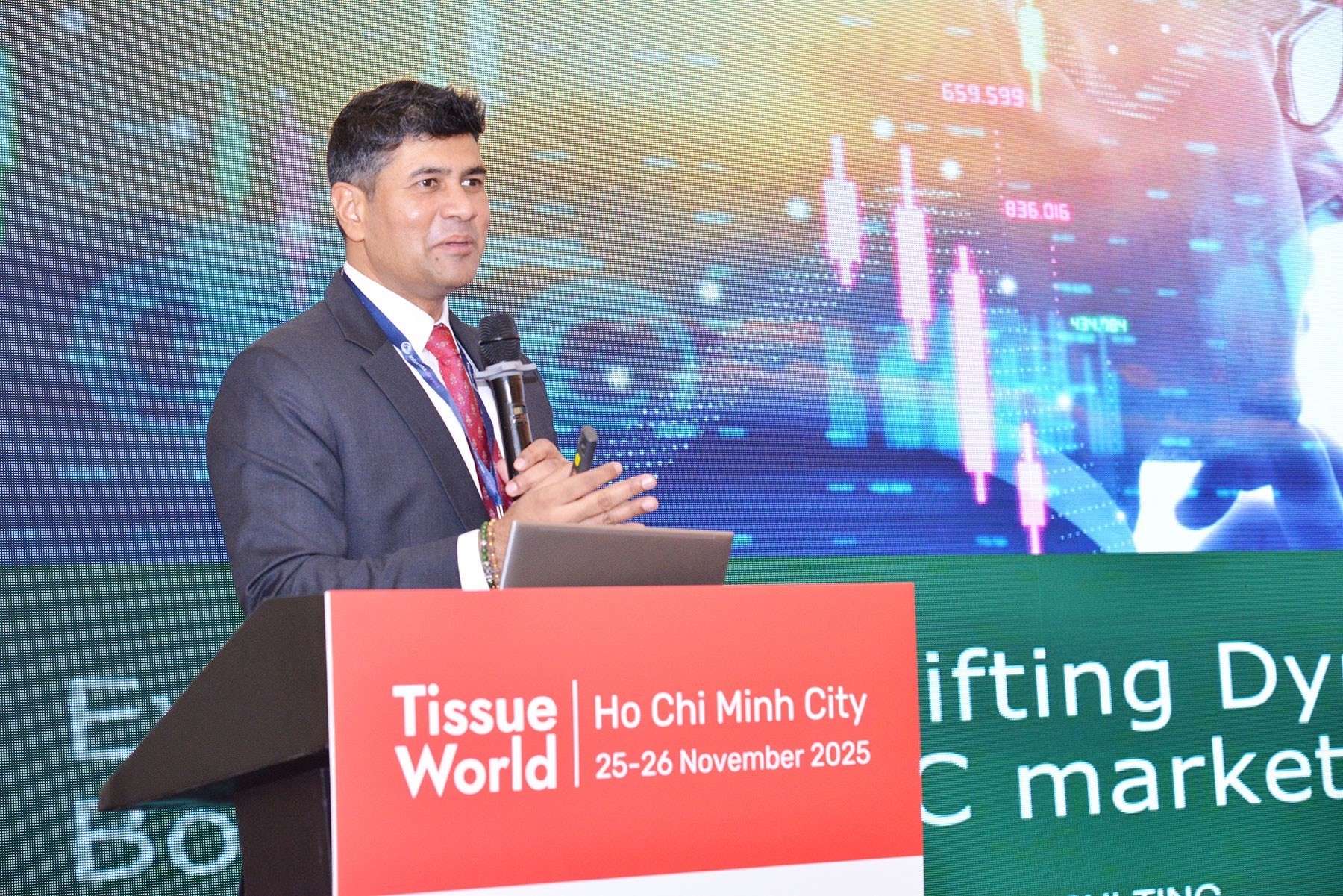
Somnath Ray, Principal, AFRY Management Consulting
Growth in personal care and food service are dominant drivers of tissue demand.
Personal care and beauty segments growing steadily:
- World +7%
- Asia +9%
- North America +3%
- Europe +2.5%
- And the food service segment is expanding…
- World +3%
- Asia +12%
- North America +12%
- Europe +9.7%
- The At-Home (Consumer) segment dominates converted product usage, with toilet paper with the larger share.
Global markets by segment 2024
- 45.4MT in 2024
- At-home: 77%
- AfH: 23%
Share of AH and AfH tissue differs by regions, driven by regional consumer habits … Future demand growth will continue to be led by China.
Fibre and energy are the most significant components of tissue production cost, hence the source of competitiveness.
Focusing on improving cost efficiencies gives the competitive edge
Key assumptions:
- Modelled consumption figure is 1.040; The SW/HW share is 10/90.
- AFRY’s model assumes 100% operating rate, no downtime, or a downgrade of the product
- Actual consumption of other variable goods (e.g., chemicals) may differ to reach a particular specification, also depending on grade mix at the site
- Actual unit prices for variable goods may be a bit different depending on specific contracts with suppliers
- Specific contracts agreements in other manufacturing costs (packaging items, felts and wires, maintenance) which AFRY have modelled based on industry standards.
- Allocation of other manufacturing costs may differ
Dynamic market situation requires balance between several competitiveness drivers
Raw materials: volatile pulp price impact – alternative fibres
Trade and logistics: friend shoring, supply chain vulnerability, transportation costs
Market dynamics: consolidation-induced entry barriers, price competition in fragmented market
Demand volatility and consumer behaviour: AfH segment recovery uneven, rise of e-commerce, innovative and high-quality product
Sustainability and environmental compliance: sustainability requirements, energy and compliance risks
Operational challenges: technology and efficiency, skilled labour shortage
… which results in the key competitiveness focus areas of:
- Improving efficiencies
- Compliance with Environment/sustainability goals
- Fibre integration
- Friend-shoring.
Integration offers cost benefits in tissue paper production, although challenge of scale differences remains.
Competitiveness by integration
Key limitations:
- Fibre availability
- Wood fibre prices
- Scale differences
- Economies of scale of a pulp line
Automation and Operational Excellence in converting gains importance in case of lack of fibre integration.
Integration to fibre supply and improving efficiencies will drive competitiveness in dynamic tissue market.
Pulp prices:
- Persistent volatility
- Diminishing pulp price peaks
- Shorter upcycles
China pulp integration
- New options to imports
- Domestic wood supply unlocked
- Substantial pulp project pipeline
Integration feasibility
- Potential for improved margins
- Tough thresholds to enter
Converting
- Automation and operational excellence important in lack of fibre integration.