
















By Luc Vanden-Abeele, Director of Marketing at NūMove Robotics & Vision. A TWM report.
SKU explosion and the automation imperative
In today’s tissue industry the proliferation of SKUs — from 1-, 2-, or 3-ply formats to cube boxes, flat packs, and soft wraps — is reshaping production demands for facial tissue. Consumers are driving this change, seeking softer, stronger, and more absorbent products in increasingly varied formats.
SKU proliferation demands greater flexibility for automation as production lines need to manufacture various products in smaller batches.
To keep up, converting equipment has become faster. End-of-line automation, particularly palletising, must also evolve in tandem to avoid bottlenecks and maintain throughput.
Engineering for speed and flexibility
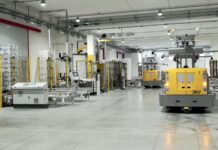
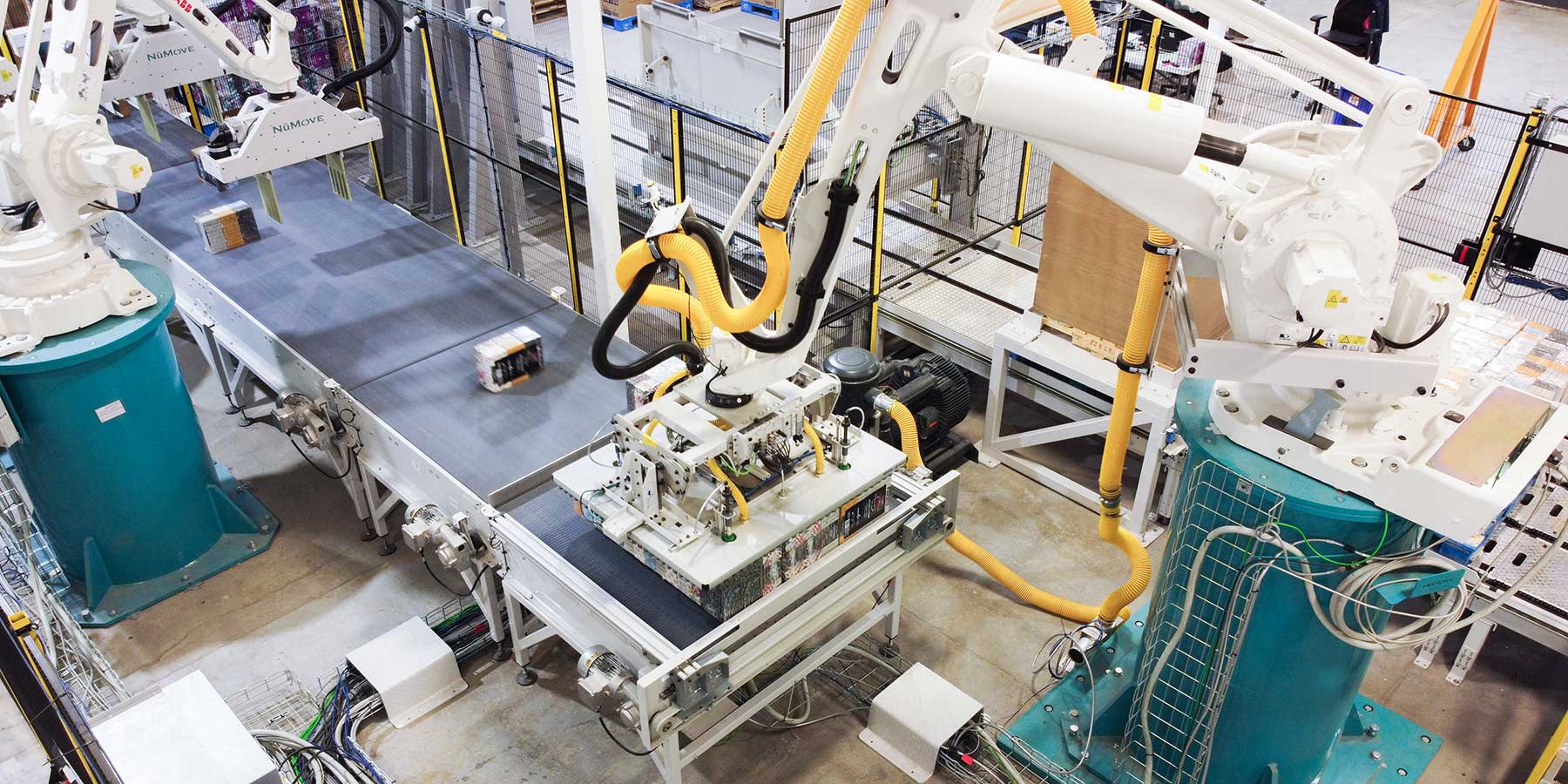
NūMove’s latest robotic palletising system was designed for a new facial tissue facility handling up to 100 distinct SKUs. The system achieves a throughput of 50 products per minute at 80% capacity.
This performance is made possible by a multi-robot configuration:
- Two side-by-side robots prepare palletising patterns.
- One robot handles complete layer palletising.
Handling packaging diversity
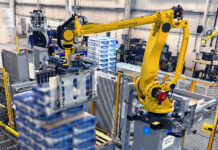
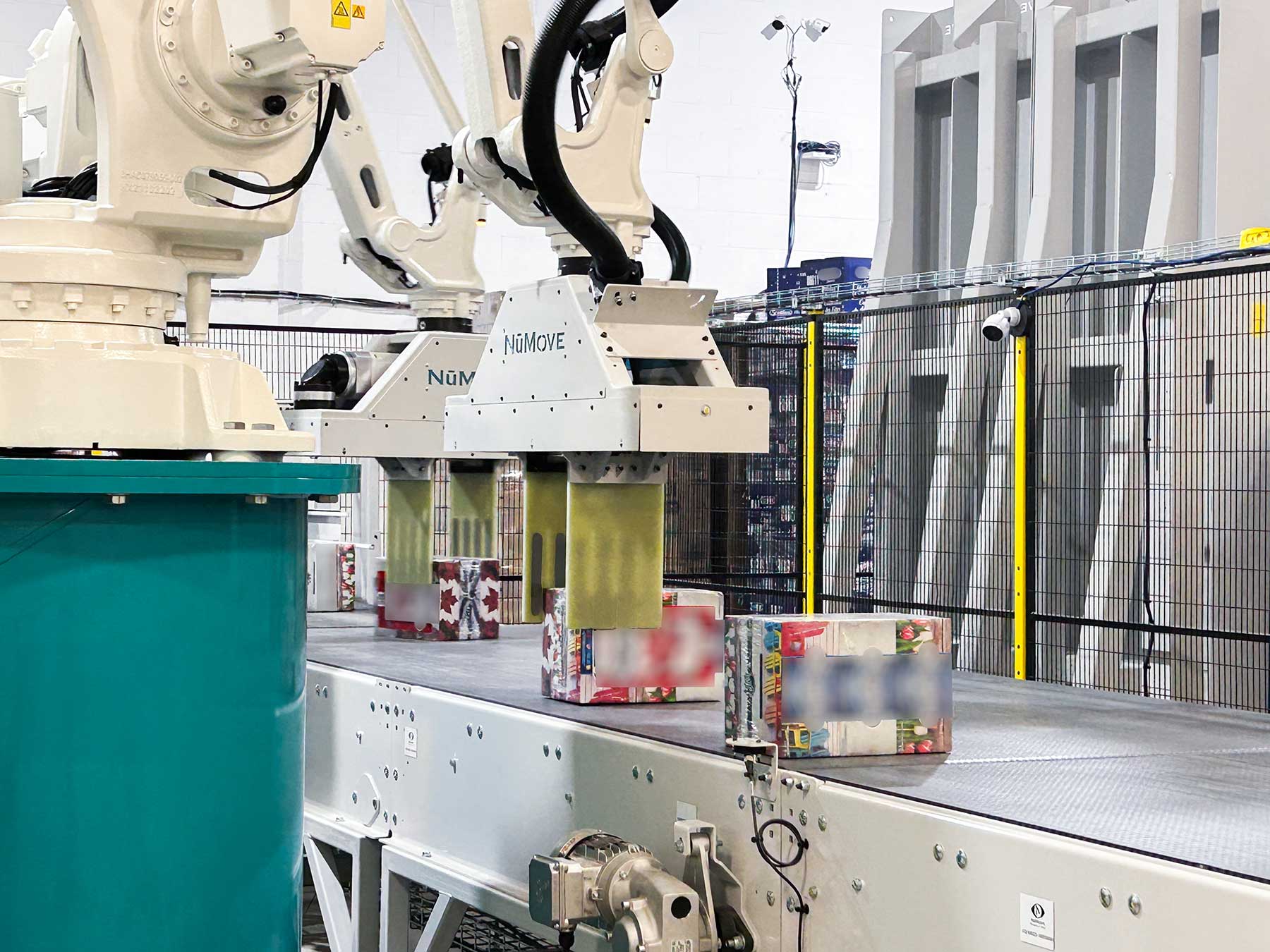
Facial tissue secondary packaging varies widely – corrugated boxes, shrink-wrapped cartons, and loosely wrapped packs. The latter are particularly challenging due to their tendency to swing during robotic handling. The end-effectors are then purposefully designed to address this.
- Pattern maker robots incorporate flexible clamps that adapt to product dimensions without causing damage.
- Palletising robot incorporates multiple vacuum zones to accommodate gaps in palletising patterns. This tool uses machine vision for layer validation, ensuring all products are within expected boundaries before palletising.
Pattern makers: mechanical vs. robotic
Since the products are handled in full layers when being palletized, product patterns must be prepared upstream. Two technologies were evaluated:
Mechanical pattern maker
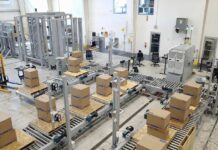
For this application, two mechanical pattern makers are needed to meet the 50 products per minute rate. Below is a short description of how it works.
- Product are fed through two separate infeed conveyors
- If needed, products are turned 90 degrees as per the final pattern requirements
- Rows of products are built and indexed into the layer pick conveyor
- When completed, the full layer is picked by the robot
While the system benefits from a well-established and proven technology, its operational limitations must be considered. With a throughput restricted to 25–30 products per minute per unit, a wide physical footprint, and limited flexibility, it may not meet the demands of high-speed or space-constrained tissue production environments.
Robotic pattern maker
Another option is to use a dual-robot approach:
- Products are fed through one infeed
- The two robots share the work and rotate, or slide products as needed to prepare the layer
- The full layer is built at the end of the conveyor
- When completed, the full layer is picked by the robot
This approach offers advantages in speed, flexibility, and spatial efficiency, making it particularly attractive for tissue manufacturers seeking compact and agile automation solutions. However, these benefits come at a cost: the technology typically requires a higher capital investment and involves more complex programming, which may demand a specialised expertise during integration and maintenance.
Robotic pattern makers can operate blind if product feeding is controlled; or use machine vision for guidance. Robot programming must account for orientation needs, collision avoidance, and fall-back scenarios where one robot takes over if the other fails.
Software-driven adaptability
One of the standout features of this robotic system is its software-driven flexibility, powered by NūMove’s proprietary software named NūLogikTM. Operators can add new products without any programming via a step-by-step wizard on the interface. This eliminates the need for tooling changes or code updates. In an industry where product innovation is frequent and format diversity is growing; such flexibility is essential.
Product changeovers are incredibly fast, no tooling change or modification is required, just a few parameter adjustments on the human-machine interface. It’s seamless and efficient.
Market outlook and strategic fit
Industry analysts project continued growth in the facial tissue segment, driven by demand for premium and customised products. This trend underscores the need for flexible automation that can adapt to frequent SKU changes and format innovations.
A robotic high-speed palletizing solution aligns with broader industry shifts toward smart factories and warehouse automation. Across the tissue industry, automation has evolved from a competitive advantage to a strategic necessity – enabling manufacturers to streamline operations, reduce labour dependency, and respond faster to market demands.
Conclusion
This high-speed robotic palletizing system sets a new benchmark for end-of-line automation in the tissue industry. Combining mechanical precision, software intelligence, and operational flexibility, it meets the evolving demands of modern production lines. In an environment where speed, SKU diversity, and adaptability are paramount, NūMove delivers a scalable, future-ready platform that empowers tissue manufacturers to stay ahead of the curve – today and tomorrow.
This article was written for TWM by Luc Vanden-Abeele, Director of Marketing at NūMove Robotics & Vision.