



















With uncertainty following a major tissue deal, and trade agreements under review, ResourceWise’s Senior Consultant Bruce Janda analyses Mexico’s rise in the North and South American industry.

This column last reviewed Mexico’s Tissue Business in 2022, when we noted that two decades of the North American free trade agreement had resulted in Mexico building a significant export-based tissue business with advanced technology and capability to compete for the American private tissue business. Mexico remains America’s second-largest trading partner, following number one Canada.
Eight more Mexican tissue machines have come online since that report. Mexico has a domestic tissue market with a wide range of performance targets. Most domestic tissue is focused on economy brands, but specific high-income areas in Mexico City see ultra-premium tissue products like those in the American market. At the same time, American tissue exports to Mexico continue to grow.
Domestic tissue consumption is estimated to be approaching 16kg per person, well above most of the rest of Latin America. Mexico remains subject to currency variability and raw material costs. Continued development of the domestic tissue business and diversification of tissue export countries will be critical to the continued growth of Mexican tissue production.
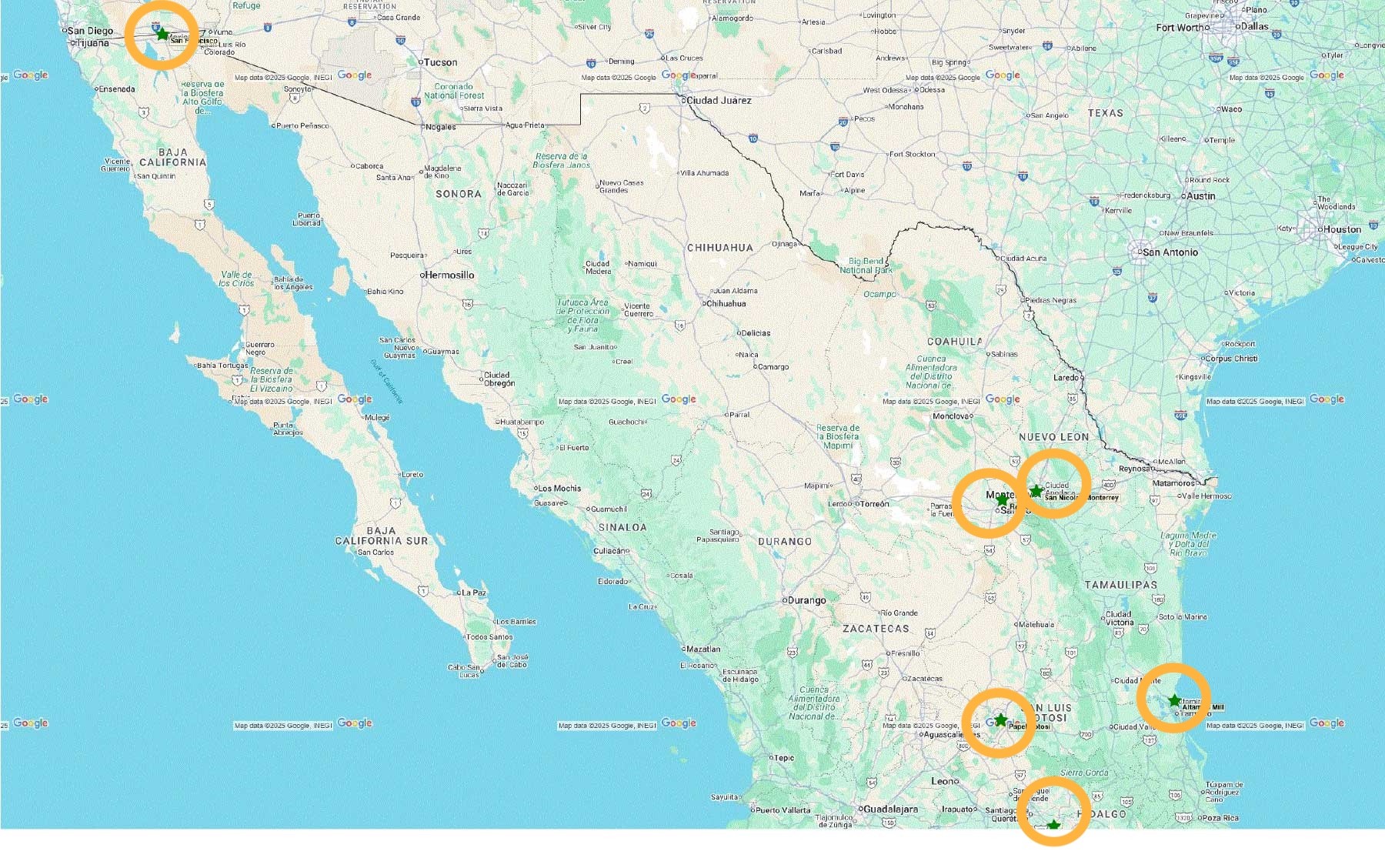
Mexico’s tissue production facilities are illustrated in Figure 1. Many are integrated with recycled fibre, though none are linked to virgin fibre. Several facilities are located near the United States border, which grants them access to free trade under the USMCA agreement (T-MEC in Spanish), despite some instability in North American trade relations. Mexican trucks and drivers can cross into the US to deliver tissue products, provided all safety inspections are met, and drivers show basic English proficiency, a new requirement for commercial driver entry. However, Mexican tissue producers must be concerned that the rules of trade could change at any time.
Mexico’s geographical position as both a Latin American and North American country has fuelled growth in tissue production, allowing direct shipments from Mexican mills to American customers. The tissue business in North and South America has been shaken by Kimberly-Clark’s agreement with Suzano. However, it should be noted that Kimberly-Clark de Mexico (KCM) is a Mexican majority-owned company that has a relationship with the global Kimberly-Clark Corporation (KCC), but the Suzano transaction specifically excludes Kimberly-Clark de Mexico.
GDP grew at 1.5% in 2024, following rates of 3.7% in 2022 and 3.3% in 2023. Real GDP per capita, expressed as PPP (purchasing power parity), is represented by the blue line in Figure 2. The adjusted purchasing power parity (PPP) of about $24,000 (USD) represents significant purchasing power to support continued domestic tissue demand. Still, about 37% of the population lives below the poverty line.


Mexico continues to be the tenth most populated country (about 130,793,927 in 2024) in the world, growing at about 0.72% per year, as shown in the solid bars in Figure 2. This growth rate is common in more developed countries, but Mexico’s population age structure is much younger than the United States or Europe, with only 8.2% of the population over 65 years.
Inflation and unemployment are key indicators of economic factors that slow down tissue consumption. Figure 3 shows Mexico’s inflation trend as a blue line. Inflation has mostly been stable, except during the pandemic recovery period, when it spiked in 2022. The current inflation rate is like that of the United States.
Unemployment is represented by the bars in the chart and is currently near 4%. Interestingly, the youth unemployment rate reported by the CIA World Factbook was 5.5% in 2024. This is very low compared to the United States or Europe. Taken together, Mexico’s economy is well-positioned to support continued growth in domestic tissue demand. We will take a further look at this when we explore the mix of tissue product formats produced in Mexico. Mexico’s tissue trade trends are shown in Figure 4 (Imports) and Figure 5 (Exports). Note that both charts are on the same Y-axis scale to allow direct visual comparison. Exports exceed imports by a ratio of about 2:1 after starting as equal in 2007-2008.
The final piece of the balance of Mexican tissue supply is the addition of tissue capacity through new tissue machines. This ignores the potential year-to-year impacts of inventory changes in the supply chain, but the results are true on average. This is normally reported with a bar chart, but a table with more detail by tissue grade is shown in Table 1 to facilitate analysis. Mexico added 17 new consumer tissue machines in the study period, while commercial tissue saw no net change as three machines were added and three were removed. Specialty or industrial tissue saw no new machines, and one was removed. This is a large increase in Consumer tissue capacity and indicates that it was targeted at the United States market, probably private-label tissue.
Tissue machine capacity tends do trend up as incremental investments and debottlenecking can add several percent capacity increases per year. However, new tissue machines tend to add significantly more capacity than replacing old and outdated machines.
Mexican tissue sites are 86% integrated with recycled fibre production from recovered paper. The remainder are non-integrated, as there are no virgin fibre-integrated tissue sites in Mexico – this high percentage of recycled fibre production positions Mexico for low-cost production of value-oriented products. Fibre applications for the Mexican tissue product by finished product type are shown in Figure 7. Consumer bath accounts for most of the Mexican tissue production and has the most variation from recycled to eucalyptus. This indicates that a range of bath tissue products are being produced, with about 70% made from recycled fibre.
Consumer kitchen roll towel is the second most common product. Here we see some eucalyptus and southern softwood that would be required for most advanced towel products. Commercial tissue products for away-from-home use are less common. Less common fibres in the Mexico furnish mix include both Soda and Kraft non-wood short fibre. Mexico has a history of producing fibre from agricultural waste, especially bagasse from sugar cane.
Mexico also has advanced tissue manufacturing technology that enhances the performance of tissue products with lower fibre grammage, as shown in Figure 9. This technology is specifically focused on bath tissue production, likely for export. Growing tissue demand and trade expansion may require further use of advanced technology to produce consumer kitchen towels that meet expectations in the United States, as shown in Figure 8. This advanced technology also shows up in consumer towel, napkin, and facial tissue products.
A comparison set of tissue manufacturing countries was selected from nearby trading partners and also countries with a focus on tissue exports to benchmark Mexico’s tissue machine quality. This set includes China (export competition), Indonesia (export competition), Brazil (exports/imports), Turkey (export competition), the United States, and Canada.
Results of this benchmark comparison are shown in Figure 9. China has both the newest machines and the slowest-running tissue machines. Indonesia and Brazil are somewhat faster than China. Turkey represents the fastest machines on average. The Y-axis of this chart is the average machine speed. This was chosen as a benchmark because it shows Mexico’s tissue machines running at higher speeds than everyone except Turkey, indicating technical capability. Figure 10 shows the average tissue production costs across countries in the comparison group, including Mexico. Each bar’s height indicates the cash cost per ton, while its width reflects tissue capacity. The coloured segments represent various cost components, such as raw materials, pulp, chemicals, energy, labour, overhead, and credits. Brazil, Indonesia, and Mexico have the lowest costs compared to the other tissue producers. However, the stacked cost types show that Mexico has the highest energy cost per ton of any of the comparison set.
An alternative approach to cost comparison uses the cost of an equivalent case of product, adjusting the basis weight or grammage to equalise performance. Brazil, Indonesia, and Mexico have similar average costs. The United States greatly exceeds the rest of the tissue-producing countries with a total of 46% of all production using advanced technology. The adjusted amount by case would be well over 50%. Consumer bath in the United States is 58% advanced technology, while Consumer towel is 81% advanced tissue process technology. Mexico has deployed more advanced tissue processes than most but not to the extreme of the United States.
Figure 12 illustrates the relative average viability of the comparison country set of tissue machines. The FisherSolve Next algorithm utilises estimated capital requirements, cash production costs, machine size, technical age, grade risk in the local economy, internal company risk, manufacturing competitiveness of the area, tons per unit trim, and export destination charges. Turkey, Indonesia, and Mexico hold the most viable positions, followed by Brazil and the United States. Meanwhile, Canada has significantly lower viability scores for their tissue capacity. Fibre costs and high technical tissue machine age are the major issues.
Figure 13 illustrates Scope 1 (on-site fuel) and Scope 2 (electricity) carbon emissions per the ton of finished tissue produced. The data indicate that Brazil, Canada, and Mexico’s carbon emissions are relatively low. The stacked bars indicate that this is due to different factors. Canada enjoys very low-carbon electric power (scope 2) due to the availability of carbon-free hydro power. Mexico is reasonably balanced, but has relatively high fossil fuel (scope 1) use on-site. China and the United States continue to be at the high end of emissions per ton. The United States would look improved if the lower basis weights for advanced tissue were factored in.
Mexico Tissue Summary:
Mexico is recognised among global tissue producers for its low average production costs.
Despite lower overall costs, Mexico has the highest energy cost per ton compared to other countries in the comparison group.
Carbon emissions in Mexico are moderate, primarily due to substantial on-site fossil fuel usage.
The country ranks highly in tissue machine operational viability, just behind Turkey and Indonesia.
Mexico has adopted advanced tissue processing technologies, though not to the same extent as the United States.
The Mexican tissue industry is influenced by fluctuations in fibre prices, evolving environmental regulations, and shifting trade policies.
Ongoing trade adjustments with the United States provide the greatest risk to Mexico’s tissue business.
A detailed understanding of tissue producers and their individual machines is crucial for analysing the competitive landscape. This article presents an overview of the current tissue industry in Mexico. Fluctuations in fibre prices, exchange rates, and environmental regulations create both opportunities and challenges for industry participants. American trade policy development and revision is a unique risk to the Mexican tissue industry. Moreover, changes in ownership and consolidations are expected to persist among tissue mills in Mexico, while investments in tissue-making capacity from neighbouring countries may impact imports and exports.